Showing posts with label watercolor. Show all posts

Thursday, January 29, 2026

Working with perspective

In a recent workshop with Leigh Ellis we reviewed the artist rules of perspective that is used to make objects look three dimensional on a two dimensional piece of paper.  It also conveys scale and realism to a painting. 

This is done using: converging lines, vanishing points, color intensity and shifting, edge definition, shadows and highlights.  

For example, the converging lines in this sketch meet at the vanishing point on the right edge of the paper.  They were used to define the height of three people walking toward the vanishing point.  


The same converging lines and vanishing point were used for the watercolor, below along with the other tools mentioned above.  
  • The light from above is brighter around the closest person, making both the highlights and shadows around them stronger. 
  • The closest red umbrella is brighter, while the others are paler and shift to a red-blue.
  • The edges of the closest person where light and dark meet are distinct, but they are less distinct on the further people.

In some cases additional vanishing points are needed to define your view.  For instance a house on a corner would need two vanishing points.  Shadows from the sun or clouds overhead would need additional vanishing points.   


Wednesday, December 3, 2025

Additional 2025 watercolors from workshops

Here are a few other watercolors from workshops with Leigh Ellis.  In each workshop we worked from photos.  I did not take the photos, and the paintings are not replicas of the reference photos.  

Snow!
We worked on a winter scene of a forest with a stream in the snow.
  • First a light sketch of the stream and surrounding trees.
  • Then a splattering of masking for snow
  • Add light wash for the sky and background trees
  • Paint the dark foreground trees and their shadows on the snow banks
  • Darkening the background trees and add shadows to the snow banks
  • Painting the reflecting light on the stream and the shadows of the banks
  • Darkening edges of the banks, rocks and trees         
  • Create additional depth with shadows and highlights
  • After the painting is completely dry, remove the masking 


Birds in winter and summer
Because we are so familiar with birds, getting many details correct is important:
  • Size and shape of the head, body, tail and wings.
  • Color of key characteristics that identify the species.
  • Realistic body positioning when perching or flying.
  • Correct habitat can also be important.
Birds are very round, and the illusion of roundness on a flat piece of paper is created by creating shadows and highlights.

The colors in the shadows can be cool or warm
  • Cool colored shadows (bue-purple) indicate a winter day
  • Warm colored shadows (brown-purle) indicate a warm summer day

Monday, December 1, 2025

GWS workshop with Iian Stewart

On Aug 16-18 2023,  I attended a three day watercolor workshop, hosted by the Georgia Watercolor Society at the Thomasville Center for the Arts.   The workshop “Painting Land, Sea and Sky” was lead by Iain Stewart, a sought after watercolor instructor.  

Iian is an avid sketcher, and he asked us to bring a sketch book to the workshop.  We used the sketch to make pencil sketches, take notes on design ideas, and paint studies and vignettes.  This is how every painting we did started.


A list of the watercolors Iian uses was suggested for the workshop.  I normally use just 10 colors, and mix what I need from these.  But I was interested in seeing how Iian would use these other colors, and this was my opportunity to try them: Cadmium Scarlet, Naples yellow, Undersea green, Cobalt turquoise, Phthalo blue turquoise, Verditer blue, and Lavender.  


Iian helped us improve our sketching and painting ability. I learned new techniques and was reminded of techniques I learned long ago but forget to use.  


Tomasville is a lovely historic Georgia city.  The downtown has several nice local shops, restaurants and drinking establishments.  While walking around we looked for the lost quail and one of the oldest live oak trees.  We enjoyed tasting some unique drinks at 1861distillery , had a wonderful meal at Chop House on the Bricks and took home some amazing chocolates from sweet cacao chocolates.  


Saturday, January 25, 2025

2025 watercolor workshops with Leigh Ellis

I have taken several watercolor workshops with Leigh Ellis through the years.  I love her paintings.  They glow with light and energy.  So when I heard she had weekly small group workshops I quickly signed up.

The first workshop we worked on painting light.  We did two still paintings one of white flowers and the other of a hay field in the sun.    


The flowers were white on a dark background.  To retain the white of the flowers we masked them, then painted the background.


Once the background was dry, the masking was removed and we painted the branches as flower shadows.


The Hay field was painted in several steps.  First the barn and highlights of sun were masked.  Then a double wash of blue sky and yellow field were layed down on the paper.  Then the tree line at the fare end of the field and the grasses along the front are painted in.  


Below, you can see the painting with masking (pale blue on the barn and hay bales), the washes of blue sky and yellow field, pale green trees in the background and grasses in the foreground.


I did some color testing to determine how I would handle the barn and trees.  


I used quinacridone gold orange and rose; along with mixed greens from cobalt and phalo blue.  


I find testing the color combinations and mixes before adding them to the painting is an important step.  


                                    Below is the finished painting


Friday, June 28, 2024

Travel paintings of Scotland 2024

 We had a great wildlife tour with St. Hilda Sea Adventures.  We spent 10 days on the Speideren, a 75 ft Norwegian Rescue boat in the Outer Hebrides.  We stopped at 12 different Islands during the trip seeing beautiful scenery and wildlife. 

We boarded the ship in Oban, then traveled through Loch Melfort to our first stop Rum to walk at the Nature Reserve, then on to Canna where we anchored off shore.  Next stop was the Outer Hebrides.  We hiked to a remote beaches of Vatersay, stopped at the harbor of Castlebay on the Isle of Barra, then Lochboisdale on South Uist and Lochmaddy on North Uist where we hiked out to Loch nam Maddaah to see a Camara Obscura and had a day tour out to the small Island of Berneray.  Next we sailed to the Shiant Isles, three rocky  islands in the Northern Minch, that are nesting grounds for thousands marine birds (puffins, guillemots, razorbills, shags and great skuas).  Then we were off to East Tarbert on Isle of Harris and a stop at the local distillery.  On our way back we stopped at the Isle of Sky to hike up to Loch Coruisk, and Isle Eigg for a walk, and Lochdon on the Isle of Mull to tour Duart Castle.

We stayed a few extra days to tour the Isles of Mull and Iona.

We were very busy so I only had time to make quick sketches and take reference photos.  I finished the watercolors after we returned home. 


Oban harbor at night


Kinloch Castle on Rum in process


Vatersay bay, Outer Hebrides in process


Friday, April 14, 2023

Abstraction through Design workshop

I participated in a three day abstract watercolor workshop lead by John Salminen

I am not an abstract painter, but over the course of the workshop I discovered that thinking about what makes an abstract painting is interesting can help make more interesting paintings.  Without a defined subject it is the elements of the painting that make it interesting.  The play of colors, dark against light, warm against cold, lines against shapes.

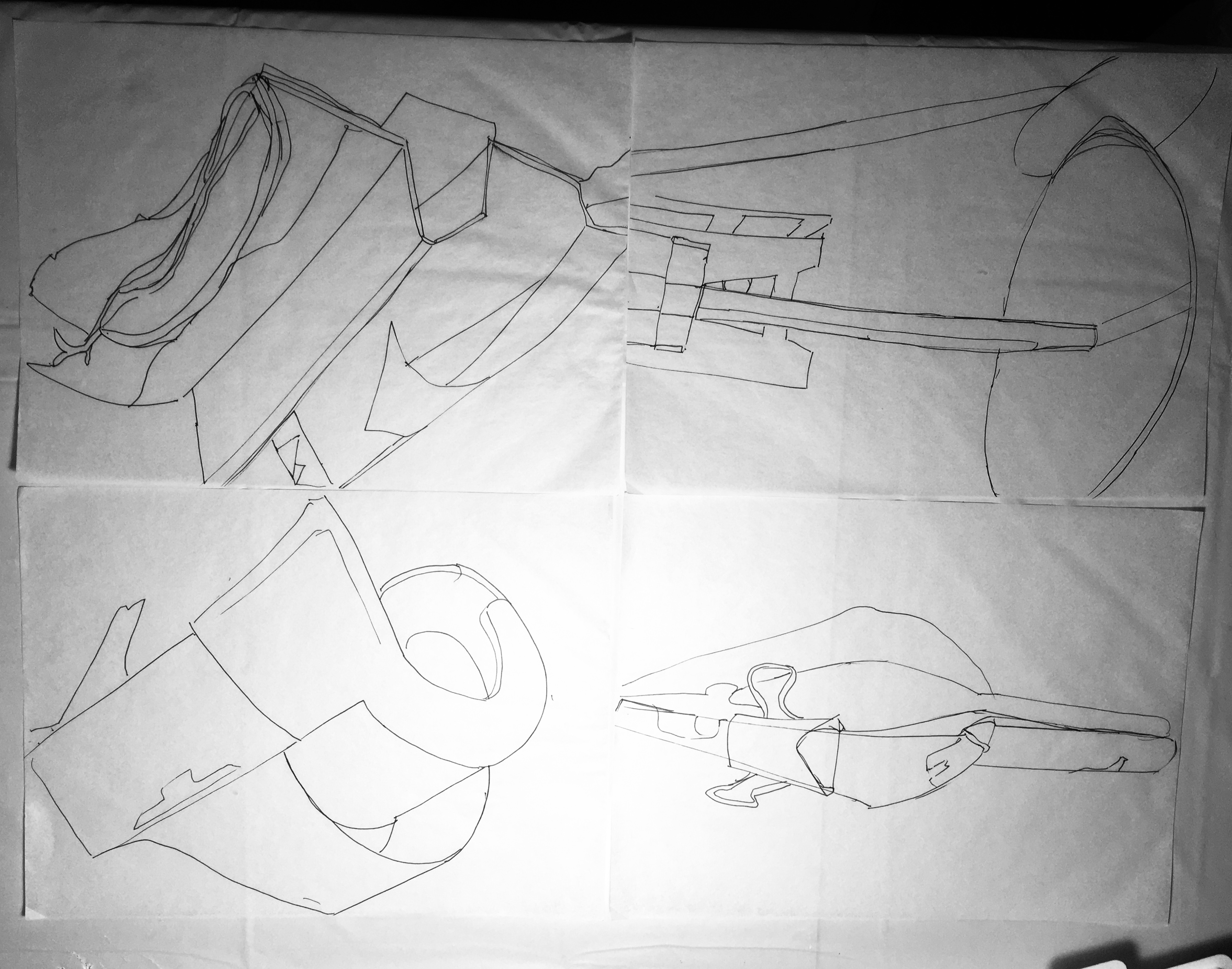
We went through a process of creating a very busy line drawing of random shapes. 

Then we used the lines to help us create a painting with a three armed white object, more or less in the center of the paper, bounded by color.  

The next step was to add some black shapes to define some contracting edges.  Then additional warm and cold colors were added to create interest and movement.  Once I started painting it became easier to add more colors to the painting.

The final shapes we added were cut from magazines and applied to the painting using matte media.  The resulting paintings were very interesting.  This was the hardest part for me.  It took a long time to find items to use and to decide where to add them.  I'm still not sure it is done.

Tuesday, March 14, 2023

Little bound story book

I purchased a stuffed Ossabaw Sicilian donkey for my nephew.  He is quite a Winnie the Pooh fan, so I decided to also get him a stuffed Eeyore, and to make a little book about the two of them meeting.  

After roughing out a story,  I had an idea of how many illustrations were needed.  I started working on sketches,   Over time, a rough story and illustrations slowly converged into what could be a little story book.  

It would have 8 pages.  I would need 10 illustrations: front cover, front page, 6 for the story, back page and back cover; and the text needed to fit in the available space of the 6 story pages.

I used watercolor paper for the 4 signatures (8 pages) of the book.  The illustrations were inked and painted.  Then text was added to the pages.  Finally I sealed the pages with a non-toxic watercolor sealant.  Finally I was ready to put together the little story book.  

 Punching the covers
Last page and inside of back cover
Bound book


Friday, December 16, 2022

Tropical watercolor journal entries


I had the opportunity to spend some time on a boat sailing around the British Virgin Islands.  It is a beautiful place, filled with brightly colored towns, white sand beaches, wonderful people, and tropical sunrises and sunsets.  I made a few watercolor sketches of places we visited.

Anegada beach

The Baths        

Trellis bay        


Saturday, September 10, 2022

Ossabaw beaches, turtles and donkeys

 We spent a few days on Ossabaw Island learning about their Turtle program and the island's ecology.  This is the largest barrier island on the Georgia coast.  It has thousands of acres of salt marsh, fresh and salt marshes, and several miles of undeveloped beach.  The island was designated as a heritage preserve in 1978, by Governor George Busbee.  

There are several buildings on the north end of Ossabaw Island.  The Boarding house and Club house are used for visiting groups.  The historic tabby houses built in the early 1800's which have been carefully restored.  This is also where the small herd of Sicilian donkeys are often seen.


Five species of sea turtles are found in the waters off Georgia’s coast, but only one, the loggerhead sea turtle regularly nest on Georgia barrier islands.  Turtle researchers spend most of their time cruising the beach looking for turtle tracks made by adult females coming ashore to nest, and hatchlings scampering across the beach to the ocean.  They work from sundown to sunrise.  Early one morning we met one of the researchers on South end beach and were able to watch two recovered hatchlings head out to sea.  This beach has a extensive Ghost forrest of hauntingly beautiful trees.

There are extensive salt marshes along the western side of the island.  I used these photos as references for a watercolor in my field notebook.


Sapelo views

Sapelo Island is one of my favorite places to visit.  The large live oak trees, vast marshes and empty beaches are sublime.  It is worth the effort to get up early to catch sunrises on the beach.  


The road out to the lighthouse along the marsh has quite nice views.  I did the sketch for this plein air and finished painting it using the reference photo.


I also did a sketch of the Renold's Mansion.  It is a Georgia State Park, where you can stay!


Saturday, June 11, 2022

Found on the beach

We had the opportunity to visit Little St Simon's Island for a Georgia Audubon 3 day Ornithology workshop.  We had a wonderful time helping the researchers band Painted Buntings (and other birds); count nesting spoonbills, storks, ibis, herons, egrets and anhinga in the rookeries, and checking on nesting sea birds at the beach.  


While on a trek up the beach to see Wilson Plover chicks and American Oystercatcher nests we notices a bouy that had washed ashore.  I took several photos from different angles as references.   I used a panoramic photo for the watercolor sketch in my travel journal.  


Saturday, April 30, 2022

OCAF & GWS watercolor workshop

Transparent Watercolor on Paper and experimenting with Mixed Water Media on Yupo, a workshop by Mark Mehaffey.  This workshop was offered as part of the 2022 Georgia Watercolor Society's National Exhibition held at OCAF.

It was three day zoom workshop.  During the workshop he provided us with information on his painting methods and techniques.  We were able to ask questions and share our work-in-progress for critique and assistance.  We looked at some of Mark's paintings as part of our discussion.  I would describe the paintings as abstracted realism.  We spent time on planning our paintings.  Using exercises to help us develop the relationship of the shapes, color values.  I learned a lot from the workshop.  

Value studies:

The first watercolor painting was done on heavy watercolor paper with two coats of gesso.  This treatment adds texture and allows easy lifting of paint.  To preserve the paint a sealing coat is sprayed on the painting.  I used a photo of the Grand Tetons from a trip several years ago as my reference.  

This watercolor was done on Yupo, a plastic paper that allows paint to easily flow across the surface.  Paint can also be quickly removed with water.  To preserve the paint a sealing coat is sprayed on the painting.  These are total abstracts.