Showing posts with label fishing. Show all posts

Friday, September 13, 2019

Fishing and sketching in Western Montana

Four of us went out to visit a friend who had recently moved to Montana.  We stayed in a single story log Forest Service Cabin down the road.  Like our previous cabin, this one had outdoor plumbing, but is entirely electricity (lights, stove and refrigerator).  The homestead was built in the 1890s by a former slave and her common-law husband. This cabin and the one we had previously stayed in were restored by Forest Service volunteers.   

The river was an easy walk across the field. We often saw Moose crossing the river near where we fished.  We hiked and fished along the river most days.  On this trip I caught and released my first Cutthroat Trout.  


We also did some sight seeing in Missolua and Philipsburg.  


Driving on the narrow twisty dirt roads that follow the rivers we encountered deer and big horn sheep.


Friday, September 14, 2018

Montana land of the big sky

Six of us headed out to Montana to do some fly fishing.  We rented a Forest Service Cabin; a log homestead built in 1917.  It sits in the valley between tree topped hills along side a small rocky creak that flows into a bigger rocky creek where we fished.

The fall landscape is beautiful.  Winding blue water framed by Golden grass covered fields and tall green pines with red bark; tree covered hills with Rocky outcrops; brilliant blue skies with billowing white clouds.

The two story cabin had a propane stove and lights.  It didn’t have a refrigerator, so we kept our food in coolers on ice.  A shed behind the house contained the pit toilet, shower and wood storage area.  The largest part of the shed was occupied by wood, since we used the central wood stove to heat the house.


While painting the cabin I notice movement in grass, a mountain grouse was out foraging.


We spent most of our days fishing and relaxing on the porch.  I caught and released several Rainbow and Brown Trout.  


Monday, September 10, 2018

Fly fishing and sketching

I have been fishing my whole life.  By the time I was five, I was helping clean the fish we caught.  Blue fish, Striped Bass, Rock fish, Porgies and Blowfish were all common in the sound and bay.  I spent my time near the water, on the water, and in the water every day of summer vacation.  If we weren't fishing we were scalloping or clamming or sailing or swimming or walking the beach.    

I learned to Fly fishing much later in life, but found it to be just as wonderful as my childhood summers.  I am outside standing in a clean rocky stream surrounded by forests, fields and mountains.  I fish for trout use barbless hooks, and practice catch-and-release.  Casting is more challenging and getting your line tangled more common, and the frustration can ruin an otherwise great day.

When I start to get frustrated I find a place to sit, drink some water and do a few sketches.  I carry a small  pocket sketch book and pencil in my waders.  I sketch what ever is around me.  After a few sketches I am calm and ready to start fishing again.


Friday, September 23, 2016

Fish live in beautiful places 2

I don't carry a watercolor kit on me when fly fishing, but I do have one in the truck.  Often it is a hike from the truck to the stream, but sometimes you can park very close to the stream.  I took advantage of fishing close to where the Truck was parked to painted the below view of a beautiful small headwater stream of the Davidson river, NC.

It was done in my Moleskin water color notebook using my Van Gogh  Watercolor Pocket Box.  The various shades of green were made using a pallet of: Yellow Ochre, Burnt Sienna, Ultramarine Deep, Cerulean Blue, Permanent Red, Madder Lake Deep, Permanent Yellow and Azo Yellow Medium.


Friday, September 16, 2016

Fish live in beautiful places

I carry a small moleskin sketch book and pencil in a pocket of my Fish Pond chest pack, just in case I feel the urge to sketch while I am out on the river.  When I take a break to drink some water, change a fly or unravel a knot, I will stop to do a quick sketch of a falls, riffle, river bank or other angler.

After spending the afternoon fishing the Gibbon River where it twists through grassy meadows in Yellowstone NP (photo to the right), I did a quick pencil sketch of the bright purple wild flowers along the trail.  I included some notes to help me identify the plant at a later time.  It matches the description of the Thick Stemmed Aster, Eurybia integrifolia.


Friday, September 2, 2016

Vast open spaces in a small sketch book

I was recently out west, where Idaho - Wyoming - Montana meet.  This area has vast open plains, tall craggy mountains, brilliant blue skies and many beautiful rivers.  I spent most of my time fly fishing in Yellowstone National Park, but also was able to tour some of the attractions at Yellowstone National Park and Grand Tetons National Park.

Below is a sketch I did of the distant hills, after spending the day fly fishing the Gallatin River, Yellowstone NP.  Like many rivers, this one begins in the mountains and is formed by rain, snow melt that flows into small creeks.  We were fishing in the valley where the now wider river begins to meander.  The banks of this swift flowing rocky river are lined with dense willows.  I was told that moose like to bed down among the willows, but happily we didn't run into any while we were fishing.  The coolness of the water was a refreshing complement to the sunny warm day.


Saturday, March 12, 2016

Watercolors printed on mugs?

I have been using my Canon Pro9000 Mark II series printer to print archival pigment prints on Strathmore 90lb watercolor paper note cards for a while now.  Last past year I donated sets of flower, trout patterns and salmon fly cards to Trout Unlimited, library and other local groups for their fund raisers.

This year I decided to try something different.  I downloaded a template for a wrap around mug and painted four watercolors; Brown trout, Rainbow trout, Brook trout and Cutthroat trout.


I tried to create images that looked active.  The scanned 300 dpi images were uploaded to a commercial web site to be printed on mugs mugs.

I loved the way the mugs turned out, the colors closely match the original watercolors and the fish look great wrapped around a mug.

The mugs will be donated to local Trout Unlimited chapters for their fund raising events.


Saturday, June 20, 2015

Brook trout

On a recent trip to North Carolina I was able to do some fly fishing on the North Mills River.  It is a tranquil river with lots o big rocks, riffles and deep pools for trout.  I like nothing better then to stand in the river's shallows and watch a trout rise to the fly I am floating down river.

Sometimes all I see is a dart, a quick look and total dismissal from the fish.  The fly was the wrong color or style, didn't smell right, floated to high in the water, moved to fast or not fast enough.  Whatever was wrong it was wrong enough to make the fish decide to pass on my offer.  The only reason I see these fish is the flash of their lighter underside as they make the quick turn back down to the depths of the pool.

Other times the fish takes a quick bite, only to spit the fly out and dive even quicker.  I'm sure the feathers, fur, thread, plastic and metal bits that make up my flies are not anything like a tasty bug.  Less often are the times the fish gulps the fly and I set the hook.  If I keep the line tight while I reel in the fish I have the opportunity to see its beauty up close, and briefly marvel over the colors and patterns covering the fish that live in the these beautiful cold water mountain streams.

I took a photo of a trout I caught on the Mills River before I released it, and later that day painted the fish.
 

Sunday, March 15, 2015

Colorful Salmon flies

I recently read an article about historic fly patterns used for Salmon fishing.  Salmon flies are nothing like the tiny drab colored insect mimic flies I have in my fly boxes.  Salmon flies are big, and bright and often mimic small fish.  I picked four beautiful fly patterns to paint for use on note cards.  Wet on wet was used to blend the base feather colors.  Additional details on the large feathers and the hackles were dry brushed.

The "Durham Ranger" is a quintessential classic pattern.  These intricately dressed flies were used for Atlantic salmon fly fishing during the nineteenth and twentieth centuries.  Fly patterns from that time used colorful feathers from large, and often exotic birds.  Today, tying these flies is considered an art.

Bits of fur, feathers and shinny tinsel are carefully tied to a hook to imitate insects, fish, other foods or just something that will catch a fish's interest.  The "Policeman" was designed for Salmon fishing on the river Tay in Scotland.  In the water, this fly imitates a bait fish.  

Different patterns are used for different types of fish and for fish from different locations.  The "Rock Island" streamer is a modern fly designed for trout fishing in British Columbia (Designed by Monte Smith).

The "Copper Lake" is a modern classic in the "Ghost" style (Designed by Monte Smith).  The first of this style, the "Grey Ghost" pattern, was created by Carrie G. Stevens, a self-taught fly tier from Maine.  The streamer was designed to be used for river casting and resembled the bait fish found there.  It remains a popular fly pattern and is still used for Atlantic trout and salmon fishing.


Sunday, February 22, 2015

More Trout cards

The third trout pattern represents a Rainbow Trout.  These trout have olive-green backs with dark olive to black spots.  A bright pink stripe of color splashes along the mid-line of the body, fading to white on the abdomen.  The small clear scales of the fish produce an iridescence where the light reflects off of them, which I represented by lifting off some of the paint.

I was satisfied with the Brown and Rainbow Trout patterns I had painted, but the Brook Trout pattern didn't look quite correct.  After looking at several photos of Brook Trout I realized what fly fishers refer to as a "worm" pattern on the back and upper sides of the trout resembles patterns seen in some corals.  Also the spots and vermiculate pattern were actually yellow, not white or light olive color which lifting the wet paint had created in previous paintings.  To achieve the pattern seen on the fish in the photos I needed to use a different painting techniques then I had been using so far.

The first step was to lay down a blended wash of Aureolin Yellow across the top of the paper and Cadmium Red Light along the bottom.  The colors join and mix just below the middle of the page.  Before the paint dried I created several "white" spots in the middle and lower half of the painting by lifting off the wet paint.  After the paint dried I added a little Winsor Blue to the "white" spots in the middle to create the halos for the red spots I would add later.

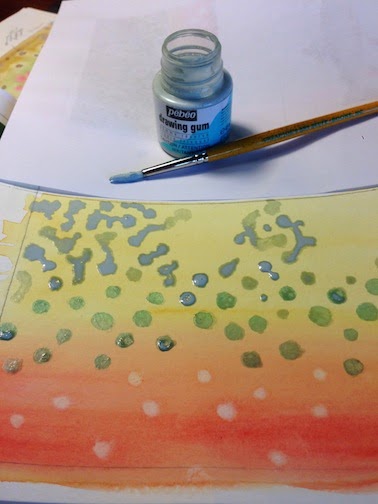
Next I used masking fluid to cover the blue spots in the middle.  I then added additional masking to the upper part of the painting to create the "vermiculate and spot" pattern trout exhibit on their back and upper sides.  In the photo to the left I had already covered the blue spots and was half way through adding additional masking to finish the trout's upper pattern.

Once the masking had completely dried I wet the upper part of the paper using a light mist of clean water.  I added a graded wash composed of a mixture of Sap Green, Burnt Siena and Raw Umber to create the olive-green and brown of the trout's back and upper sides.  Once the final wash was dry I removed the masking to reveal the lighter spots and "worm" pattern.  The photo to the right was taken when I was halfway through removing the masking.


Masking fluid creates a sharp edge where the pigment of the wash could not penetrate the paper.  I softened these edges by adding clean water and lightly rubbing the edges.  The step was to use Rose Madder to add small red spots in the center of the light blue spots.  To the right is a photo of the finished painting.

Sunday, February 15, 2015

Trout cards

I've been working on some drawings and watercolors of trout and flyfishing to use on cards for our Trout Unlimited chapter.

We have three common trout in this area of the country.  Brook Trout (Salvelinus fontinalis), Brown Trout (Salmo trutta) and Rainbow Trout (Oncorhynchus mykiss).  The first species is native to the area, and the last two were introduced.  All three are considered cold water sport fish.  The Wildlife Resources Division and the U.S. Fish & Wildlife Service stock the streams with rainbow, brown and brook trout to keep up with sport fishing demands.

These trout exhibit wonderful patterns of colors, spots and wiggly lines.  After looking at several photos of trout I started working on some cards that just show the patterns.  Below are patterns on a Brook Trout and a Brown trout.