Sunday, July 26, 2015

Volunteer Sunflowers, part 1

This year I have several volunteer sunflowers growing up in the herb garden.  Some have large single flowers and others have multiple smaller flowers.  One thing they all have in common is they tower over the much shorter herbs, gently nodding in the breeze.  The herbs have small flowers that generally attract small insect pollinators.  The sunflowers, however, attract larger pollinators.  Large carpenter bees and bumble bees, in addition to the smaller honey bees and native bees are all attracted to the sunflowers.

Sunflowers (Helianthus spp.) are annuals native to North America.  Their flowers have large centers composed of many small five-petaled florets (disk flowers) that spiral toward the center.  The outer most florets resemble petals (ray flowers).  The disk flowers on the outer edge mature first, then the next row of florets, and the next, until all the florets have opened and been pollinated.   Each composite flower is a food source for days or even weeks.

The two large bees I see most often are the Impatient Bumble bee (Bombus impatiens) and the Eastern Carpenter bee (Xylocopa virginica).  Bumble bees are smaller then Carpenter bees and have a fuzzy appearance due to numerous small hairs on their abdomen and thorax.  The larger Carpenter bees have a shiny black abdomen that is hairless.  The Impatient Bumble bees yellow hair is so pale it seems white.

Carpenter Bees are considered pests because they drill into wooden fences and buildings causing structural damage.  Bumble bees, like honey bees, are beneficial insects, and are responsible for pollinating many plants including food crops.


Monday, July 13, 2015

Apple while away

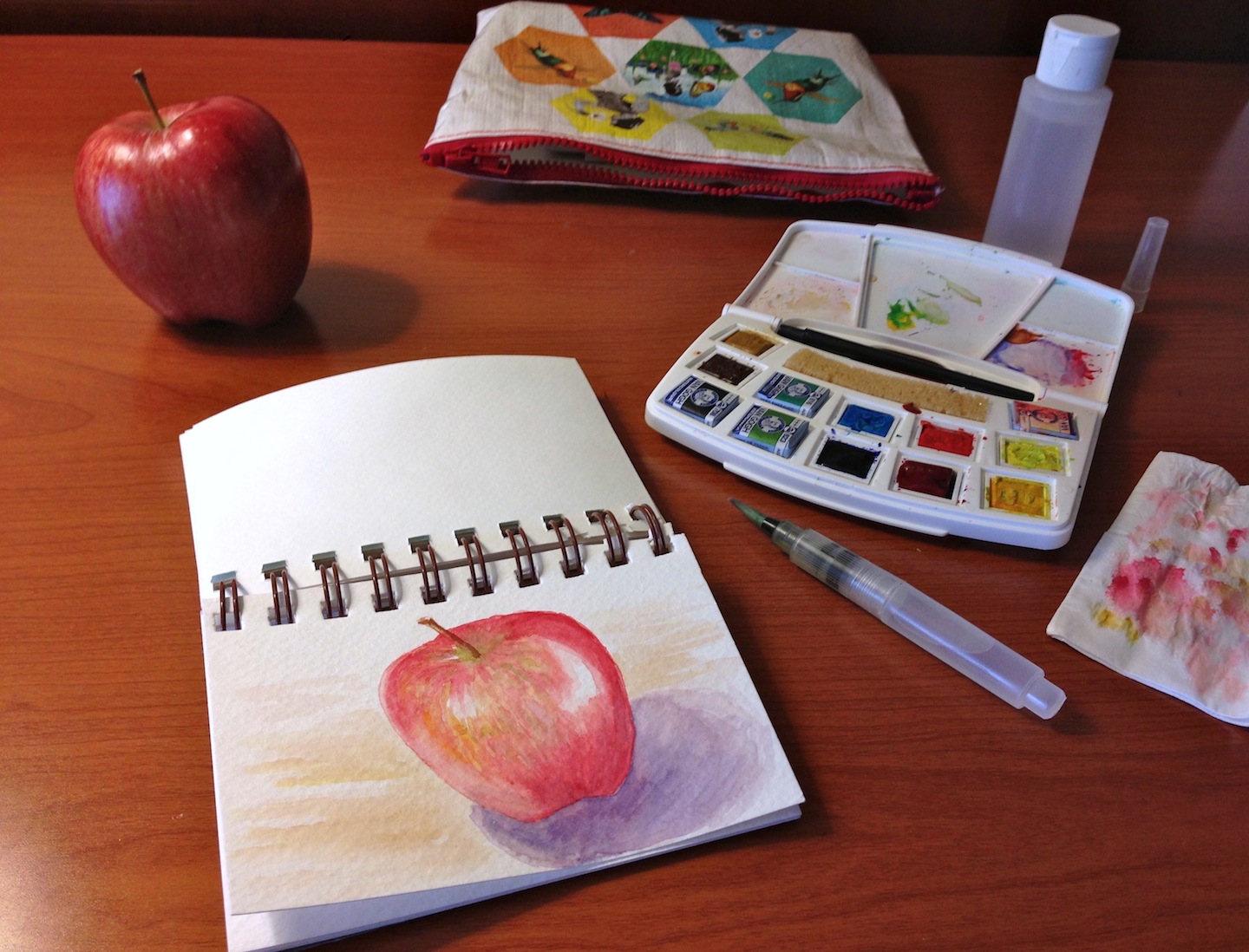
I recently took my Van Gogh watercolor Pocket Box with me to a conference, assuming I would findsomething to paint.  They was a nice view from the room, but each time I tried to paint the view I was chased inside by violent rain storms.  I ended up with some half painted landscapes.

The one sketch I was able to finish I did inside, of an apple.  The apple was a colorful mix of red, yellow and green.  The desk light cast deep shadows similar to the orange I painted on another trip.  The reflected light created highlights around the top of the apple.

Saturday, June 20, 2015

Brook trout

On a recent trip to North Carolina I was able to do some fly fishing on the North Mills River.  It is a tranquil river with lots o big rocks, riffles and deep pools for trout.  I like nothing better then to stand in the river's shallows and watch a trout rise to the fly I am floating down river.

Sometimes all I see is a dart, a quick look and total dismissal from the fish.  The fly was the wrong color or style, didn't smell right, floated to high in the water, moved to fast or not fast enough.  Whatever was wrong it was wrong enough to make the fish decide to pass on my offer.  The only reason I see these fish is the flash of their lighter underside as they make the quick turn back down to the depths of the pool.

Other times the fish takes a quick bite, only to spit the fly out and dive even quicker.  I'm sure the feathers, fur, thread, plastic and metal bits that make up my flies are not anything like a tasty bug.  Less often are the times the fish gulps the fly and I set the hook.  If I keep the line tight while I reel in the fish I have the opportunity to see its beauty up close, and briefly marvel over the colors and patterns covering the fish that live in the these beautiful cold water mountain streams.

I took a photo of a trout I caught on the Mills River before I released it, and later that day painted the fish.