Sunday, August 2, 2015

Volunteer Sunflowers, part 2


I spent a lot of time studying the sunflowers before deciding what to paint and how to approach the painting.  In the end I decided on an off center close up of the flower with a single Bumble bee feeding.

The disc florets spiral out from the center in Fibonacci sequence.  This pattern provides the optimal number of flowers and seeds for the given space.  The pattern can be easily seen in the un-opened disc flowers at the center.  My pencil sketch included the placement of the ray flower petals and the spiral lines in the center's unopened florets.

The palette I worked with included warm and cool yellows and blues; as well as Yellow Ochre, Burnt Siena and Burnt Umber.  The whole central part of the flower would involve a lot of negative painting.  Using the cool yellow I painted the whole center of the disk.  A wash of blue and warm yellow was added the center.  Warm yellow was used for the ray floret petals around the disk.  Then working from the outer edge of the disk inwards, Burnt Sienna was add to define the spent disk flowers.  Yellow was mixed in to the Burnt Siena to lighten the color as I moved toward the center and began to define the open disk florets.  Additional colors were added to darken the spirals in the center and define the unopened florets.


Background color was added between the petals and additional shades of yellow were used to continue to define the open disk flowers.  The bee was painted.  Many additional layers of color were added to develop the background, flower and bee.


Sunday, July 26, 2015

Volunteer Sunflowers, part 1

This year I have several volunteer sunflowers growing up in the herb garden.  Some have large single flowers and others have multiple smaller flowers.  One thing they all have in common is they tower over the much shorter herbs, gently nodding in the breeze.  The herbs have small flowers that generally attract small insect pollinators.  The sunflowers, however, attract larger pollinators.  Large carpenter bees and bumble bees, in addition to the smaller honey bees and native bees are all attracted to the sunflowers.

Sunflowers (Helianthus spp.) are annuals native to North America.  Their flowers have large centers composed of many small five-petaled florets (disk flowers) that spiral toward the center.  The outer most florets resemble petals (ray flowers).  The disk flowers on the outer edge mature first, then the next row of florets, and the next, until all the florets have opened and been pollinated.   Each composite flower is a food source for days or even weeks.

The two large bees I see most often are the Impatient Bumble bee (Bombus impatiens) and the Eastern Carpenter bee (Xylocopa virginica).  Bumble bees are smaller then Carpenter bees and have a fuzzy appearance due to numerous small hairs on their abdomen and thorax.  The larger Carpenter bees have a shiny black abdomen that is hairless.  The Impatient Bumble bees yellow hair is so pale it seems white.

Carpenter Bees are considered pests because they drill into wooden fences and buildings causing structural damage.  Bumble bees, like honey bees, are beneficial insects, and are responsible for pollinating many plants including food crops.


Monday, July 13, 2015

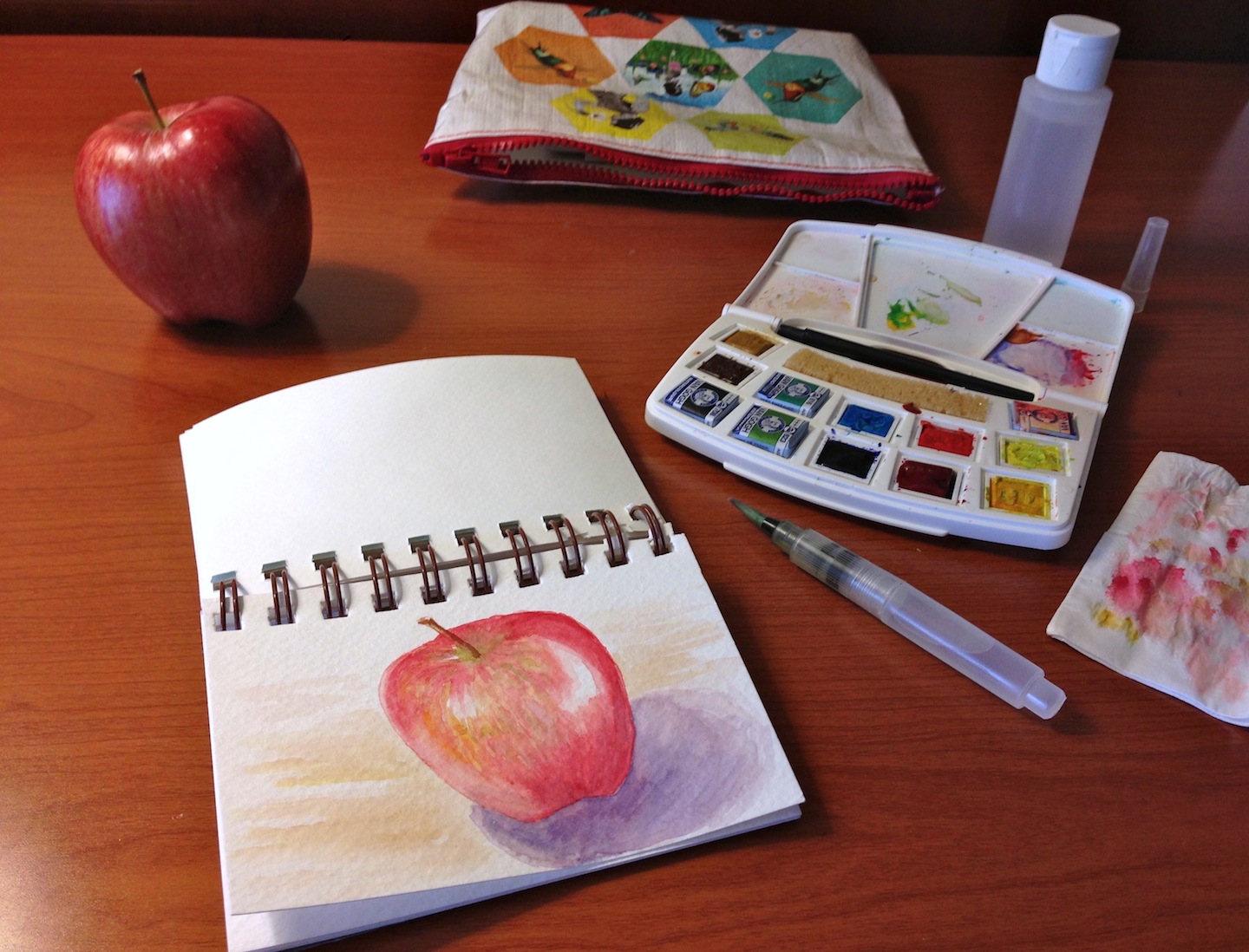
Apple while away

I recently took my Van Gogh watercolor Pocket Box with me to a conference, assuming I would findsomething to paint.  They was a nice view from the room, but each time I tried to paint the view I was chased inside by violent rain storms.  I ended up with some half painted landscapes.

The one sketch I was able to finish I did inside, of an apple.  The apple was a colorful mix of red, yellow and green.  The desk light cast deep shadows similar to the orange I painted on another trip.  The reflected light created highlights around the top of the apple.