Showing posts with label Koi Pocket Field Sketch Box. Show all posts

Saturday, June 20, 2015

Brook trout

On a recent trip to North Carolina I was able to do some fly fishing on the North Mills River.  It is a tranquil river with lots o big rocks, riffles and deep pools for trout.  I like nothing better then to stand in the river's shallows and watch a trout rise to the fly I am floating down river.

Sometimes all I see is a dart, a quick look and total dismissal from the fish.  The fly was the wrong color or style, didn't smell right, floated to high in the water, moved to fast or not fast enough.  Whatever was wrong it was wrong enough to make the fish decide to pass on my offer.  The only reason I see these fish is the flash of their lighter underside as they make the quick turn back down to the depths of the pool.

Other times the fish takes a quick bite, only to spit the fly out and dive even quicker.  I'm sure the feathers, fur, thread, plastic and metal bits that make up my flies are not anything like a tasty bug.  Less often are the times the fish gulps the fly and I set the hook.  If I keep the line tight while I reel in the fish I have the opportunity to see its beauty up close, and briefly marvel over the colors and patterns covering the fish that live in the these beautiful cold water mountain streams.

I took a photo of a trout I caught on the Mills River before I released it, and later that day painted the fish.
 

Saturday, October 25, 2014

A day at the NC Arboretum

While my husband was in Asheville for 'Hot time in the Mountains', I used my free time to do some watercolor sketching.

 I took my hiking watercolor journal kit with me to the North Carolina Arboretum, and spent a beautiful day wandering the gardens and viewing their indoor quilt exhibit.  They were just replanting their garden quilt with fall plants.  In a week the blooms will make the quilt patten pop.  There were still plenty of flowers in bloom else where in the garden.  Some of the trees were starting to turn color around the edges, hinting at a color show yet to come.

It had been so long since I did any sketches it took me a few sketches to get comfortable with my paints.   The pitcher plant's patten of bright pink and green on a background of pure white were so beautiful.  I took several photos, but only did a quick sketch since my water brush wasn't small enough to do the intricate pattern justice.  But between the photos and this sketch I will be able to do a larger painting when I get back to my studio.

The garden was a mix of late summer's brilliant annual colors and the first blush of the more earthy colors of fall.  The dying leaves of the Swamp Hibiscus and spent seed pods rustled in the wind.  Whispering ghosts of the vibrant red flowered plants of summer.  The stems still had the dark red, but the green of the leaves had faded to yellow.  The dark brown dried seed pods added a bit of additional interest to the sketch.

Saturday, June 21, 2014

Plein air river sketches continued


Georgia Watercolor Society Plein Air outing at Island FordChattahoochee River National Recreation Area.  Eleven of us setup along the trail, down river from the lodge.  The day was warm, but not too bad if your sitting in the shade along the river.  We had an hour and a half to sketch and paint.  For this outing I brought my Watercolor travel kit.

I stopped at a wide spot on the trail with a good view of the river.  As I looked out at the fishermen wading the shallows several canoes floated past.  One man had a small dog in a life vest with him.  I watched as he picked the dog out of the water by the vest's straps and let the water drip off before putting it back in the boat.  Several more rafts and canoes full of teenagers drifted past, and a large flock of Canada Geese swam out into the river from a side stream.  

I sketched one of the fly fishermen out wading the river.  Then setup my chair and settled down to paint.  The brown-red clay of the far bank ran between the fresh yellow-green of the trees and dark green-blue of the river.  A cedar house set back in the shadows of the distant trees surrounded by a lawn of bright yellow-green.  Reflections of the green and yellow trees ripple across the still areas of the river around the fishermen.   

After our hour and a half we gathered back together at the Lodge to share our experiences.  Some beautiful paintings were made by the group, and everyone had a great time.  Hope we do it again soon!

Sunday, June 15, 2014

Plein air river sketches

Plein air painting has a lot of good points, your outside immersed in nature and surrounded by inspiring views.  There can also be several obstacles.  You have to bring everything your need with you.  The weather and temperature may not be the best for painting.  Even on days that are not too hot the water evaporates fast, leaving dry puddles of paint and even dryer paper.  Unless it it raining...

After a pleasant morning of fly fishing on Shelton Laurel Creek, North of Asheville NC I traded my fishing gear for my Watercolor travel kit.  I setup next to the creek intending to sketch and paint Steve who was still fishing, however, he moved around the bend while I was setting up.  So I have a sketch of the creek san fisherman.

The creek and bank were covered with large rounded rocks.  The bank across the creek had some dying and dead hemlocks.  The result of an introduced asian insect gone wild.  The Hemlock woolly adelgid sucks the sap from the trees weakening and finally killing the trees.  Just a few years ago they were green and healthy, providing shade to the creek and its trout.  Now they are sad reminders of what is gone.  Soon the standing dead wood will fall and rot away.  Other tree species will grow to fill the gaps in the tree canopy, but they will not have the gentle shape and fresh smell of an Eastern Hemlock.    

Saturday, April 5, 2014

Of whelks and snowflakes from Sapelo Island


I recently took a weekend trip to Sapelo Island, one of my favorite places in Georgia.  I was busy most of the trip working on a Friends of the Marine Institute project, but since I had taken my watercolor traveling kit with me, I did find time to sketch some Knobbed whelks (Busycon carica) that were on the window sill at the cottage we stayed in.  Outside the window in the background is a row of Snowflakes.


Snowflakes (Leucojum aestivum) are a bulb in the amaryllis family.  Their arching sprays of five to seven blooms appear in mid to late spring.  The dangling white flowers resemble small white bells with small green spots at the end of each of the six tepals.  In the south, Snowflakes are considered an heirloom plants and passed down from generation to the next.  It was introduced to Gardens in the Eastern United States by the first European settlers.  The bulbs are tough, surviving late frost and snow as well as deer and chipmunks.  The Snowflakes in my garden always remind me of spring on Sapelo Island.  This sketch to the right is a close up of Snowflake flowers blooming in my garden.

Saturday, July 6, 2013

Trial garden

As the weather gets warmer plants and flowers fade in the heat.  One place that always has beautiful flowers throughout the summer is the UGA Trial Garden.  They specialize in plants that can handle the heat and product numerous blooms with vibrant colors.  Since many of the plants are new cultivars you never know what you will find.  

While walking through the garden the blooms of the Mexican Flame Vine (Pseudogynoxys chenopodioides) caught my eye.  By the end of summer the vines will overgrow the arch it is planted on, but right now it is just wast high and covered in vibrant orange-red clusters blooms.

The flower's orange petals open to display a bright yellow center.  As the flower ages it darkens to a deep red, and the yellow styles become a tangle of red fibers.  There is another reason to grow this vine.  The beautiful flowers attract butterflies and humming birds, which feed on the nectar. 


Saturday, June 29, 2013

Backyard birds

This year has been a wonderful year for bird watching in our yard.  We noticed a lot of wood chips on the patio and discovered a pair of Yellow-shafted Flickers (Colaptes auratus auratus) had decided to carve a nest cavity in the old Paper Mulberry tree outside the kitchen window.  The location gave us a great view of the Parent birds as they came and went, and later of the fast growing chicks being fed.  We were lucky enough to watch the chicks fledge, taking flight from a dead tree limb.  I took many photos but haven't done any paintings of them yet.

On the other side of the house a pair of Bluebirds had taken up residence in one of the 12 cubbies in our Martin house.  In 12 years, our Martin house had never even tempted a Purple Martin once, it had always been a condo for Purple Finches and House Sparrows.  But this year we are the proud landlords of two beautiful Bluebirds.  While we could watch the parent Bluebirds fly about the yard catching insects and eating berries, the Martin house is too high for us to easily view the interior.  We set up a spotting scope that allowed us to see dim shapes moving inside the Martin house.  I spent a morning working on a sketch of the parents feeding the chicks (upper part of the page).

We had cleaned out the Martin house once we were sure the Bluebird chicks had fledged and the parents were no longer visiting the house.  This was a bit of a task since the telescoping pole the house is on has rusted together and we couldn't lower it.  We ended up using a 12 foot ladder to climb up to the house to clean it.  But it was worth the effort, we were rewarded by having the Bluebirds build a second nest the very next day!

We have spotted the young Bluebirds from the first clutch in the yard.  They look like odd half sparrow half Bluebird birds, with blue wing and tail, but a brown stripped head and breast.  I added sketches of the parents and one of the first clutch immature Bluebirds to the lower part of the page.

Sunday, June 23, 2013

Sketching birds

The plan was to spend an hour or two sketching flowers at the  Georgia State Botanical Garden.  The roses are in full bloom now and they were my target.  The roses are in the new terraced garden, at the far end from the lower parking lot.   As I walked along the winding garden path on my way over to the rose garden I heard an irritated chirp chirp chirp.  As I got closer I caught fleeting glimpses of a small yellow bird flitting from branch to branch.  Stopping only to emit a few abrupt chirps before moving on.

Since I had binoculars but not a camera or bird book, I decided to take a few notes and do a quick sketch of  the bird.  This should be quick and easy I thought, and I could identify the bird when I got home.  Well 30 minutes later I was still working on the sketch.  The bird was small, fast and dodging around leaves and branches giving me glimpses of only bits and pieces.  It lead me up and back down the garden path several times.  I did however, with the help of the binoculars manage to take enough notes that with my pencil sketch I was able to identify the Kentucky Warbler (Geothlypis formosa).   This was a new sighting for me, so it was well worth my time.

The yellow underside without any spots or stripes, the black mask that extends down the neck like side burns, and the yellow stripe that wraps around the eye were the distinctive characteristics that helped me identify the bird.  After reading that these birds nest in bushes near the ground I realized the bird was trying to defend a nest (which I never saw).  This also explains the mohawk hair style the bird was sporting.  I never heard the bird's normal call, since it was so irritated with the foot traffic along the path.  

I did finally make over to the roses, but by then it was hot and there isn't a lot of shade in that area of the garden for comfortable sketching.  The roses sketching would have to wait for another day.


Friday, October 12, 2012

Little St. Simons Island, sea turtles


Little St. Simons Island is 10,000 acres and has 7 miles of beach.  This quiet expanse of pristine beach attracts shore birds and Sea turtles.  Sea Turtles are protected and their nests are carefully guarded.  During nesting season, there are daily beach patrols to locate signs of nesting and hatching.  Nests that are dug to close to the ocean are carefully moved to a new location higher up the beach.  The position of each egg in the nest is recorded and put back in the exact same position in the new nest, ensuring the embryo will have a chance to develop into a baby turtle.

Five days after the little turtles start to emerge the resident naturalist excavates the nest, counting the hatched and unhatched eggs.  We were able to watch two nest excavations while we were on the island.  Baby turtle tracks marked the progress of earlier hatchlings leading from the nest to the ocean.  Not all the tracks made it to the ocean, some were intercepted by Ghost Crab tracks.  Ghost Crabs, Ocypode quadrata, are the major predator of hatchlings on the beach.

In one of the nests two small, 2 inch, hatchlings were found digging their way up through the sand.  We all  watched them crawl down the beach, cheering when they finally reached the ocean.  The majority of sea turtle nests on the Georgia coast are from Loggerhead Sea Turtles, Caretta caretta.  The hatchlings we watched may spend some time in the marshes or near the coast of Georgia, but they ultimately swim out to the Sargasso Sea where they spend 7 to 12 years.  Juvenile turtles return to coastal waters where they grow and mature.  In about 35 years (2047) the females from these nests will return to dig their own nests.

While at the beach I did a sketch of a shrimp boat that was passing off shore.  Shrimp boats can be a hazard to Sea Turtles.  Turtles breathe air and if they become trapped in a shrimp net they can drowned.  After many years of research, a turtle excluder devices (T.E.D.) was developed and is now required on all shrimp nets.

Friday, October 5, 2012

Lt St Simons Island, history

This island has a rich history.  The Lodge (in the photo at left) and other original Berolzheimer family houses are situated near the landing dock.  This cluster of buildings sit under a tangle of ancient Southern Live Oaks (Quercus virginiana), dripping with Spanish moss (Tillandsia usneoides) and the occasional Ball moss (Tillandsia recurvata).

Helen house, one of the family houses, can be seen in the background of this sketch.  Sitting just past the white picket fence in the shade of the Live Oaks.  A bird bath and Brown-eyed Susan, Rudbeckia hirta, in full bloom sit between Hellen house and the dock.  Surrounded by a sea of prickly dry grasses.  An oasis for the birds and butterflies.  


When you step off the dock, away from the open expanse of marsh and open area around the buildings, you quickly step into what seems like a jungle.  Giant Live Oak, Cedar, and Pine trees filter the sun light and a thicket of Cabbage Palms cover the ground.  Flocks of Wood Storks (Mycteria americana) and Spoon Bills (Platalea ajaja) pass overhead on their way to the marsh.  


Sunday, September 30, 2012

Little St. Simons Island in the fall

Little St. Simons Island is one of my favorite islands to visit.  This year we visited the island in fall.  It was still hot in the middle of the day, but morning and early evening were quite nice.  Painting in the early morning and evening was also when the light was best.  We stayed in one of the modern houses which have a beautiful view of the marsh.  So I could sketch while I drank my morning coffee.  Perfect!
To some people the marsh is just a bunch of grass and water that often smells.  But Georgia's salt marsh is really an amazing place.   It is also always changing, with the tide, seasons and years.  As old channels become clogged with mud and spartina and new channels form.  The new green spartina of the spring fade to yellow in the fall.  The early morning sunlight shines on it and the spartina turns to gold.  Earning the name "the golden isles".

The blue of the sky is echoed by the blues of the rivers and creeks, along with reflections of the greens and yellows of the spartina and the red of the mud banks at low tide.  The marshes protect the land from tidal surges, are a nursery for shrimp and crabs, and a home for many animals.  This quite ever present expanse is an unseen web of life.


Thursday, September 27, 2012

State Botanical Garden of Georgia, building

The Conservatory building can be seen from the International gardenHerb and Heritage gardens.  I find bits and pieces of the building in several of my sketches.  I like the way the building reflects the environment around it, as well as the contrast the hard scape against the organic shapes of the garden that the man made structures in provide. 
This sketch was done from the other side of the arch in the photo, looking across the lawn the large glass building reflects the blues of the sky and greens of the forest trees that surround the lawn.  It was one of the many days where fleets of clouds filled the sky, passing over head on their journey from the mountains to the sea.  
This is another view of the small pavilion in the photo above.  This sketch was done from the lawn sitting on a bench in the International garden facing the  Conservatory building.  There are benches all around the gardens which are great places to sit and sketch.  This was on a bright sunny day where there were sharp contrasts between areas where the sun lit the plants and the shadows under the tress.

Looking back toward the International garden from the Heritage garden pavilion.  I sheltered in the pavilion during a light morning rain.  The benches provided an inviting place to sit and work.  A corner of the Conservatory is just visible in the upper right of the sketch. 

Friday, September 21, 2012

State Botanical Garden of Georgia, herb garden

The Herb and Heritage gardens are laid out in formal patterns with brick edged bed.  Fences and brick walls add a solid background for the garden plants.  While arched trellises stand as gateways between garden areas.  The garden plants contained here are not as formal.  Vegetable vines climb up and over trellises and herbs insist on spilling out of their beds onto the walks.    


I can usually find flowers to sketch in these gardens.  Though I have to watch the bees that love these flowers too.  These cheerful Black-eyed Susans, Rudbeckia hirta, were in a transitional bed along the path between the International garden and the Herb garden.  In spring the same flower bed was filled with bright red poppies.  


Saturday, September 15, 2012

State Botanical Garden of Georgia, new flower garden


A new garden space was carved out of the woods between the Heritage garden and the Day Chapel.  The Flower Garden walk winds down terraces with beds of colorful Annuals and Perennials.   From the top level you can only see some of the flower beds.  Others can only be enjoyed by walking down to them.  

Terrace walls wrap the formal iris garden like a terra-cotta bowl, sheltering and hiding the garden from view.  The gardens path invites you to wander among the irises.  I used a wax crayon to preserve the white of the paper for the white irises in front of the urn.  

All the irises in the garden have wonderful color and form, but my favorite is the Louisiana Iris.  I love the soft lavender that shades to pink, and the contrasting light yellow center. 

The path finally ends at a shelter sitting on the edge of the surrounding forest.  From the shelter you can look back up the terraces to the Heritage garden, or out into the green and brown woods.

Both of these sketches were done plein air, while standing, balancing my Koi Pocket Field Sketch Box and Strathmore 5" x 8" 140 lb watercolor journal.  I'm not sure I could do this trick with larger paper.

Sunday, September 9, 2012

State Botanical Garden of Georgia

The State Botanical Garden of Georgia has grown over the years, and now contains several distinct gardens.  Early mornings are a great time to wander and sketch without many interruptions.

A trail leads from the lower parking lot across a bridge to the International garden.  In spring and summer colorful flowers fill the flower boxes on the sides of the bridge.  This garden highlights the plants discovered by the famous explorers John and William Bartram and Ernest Wilson.  There are numerous flowering trees and bushes along the path, and trails that wander into the woods where shade loving plants reside.  


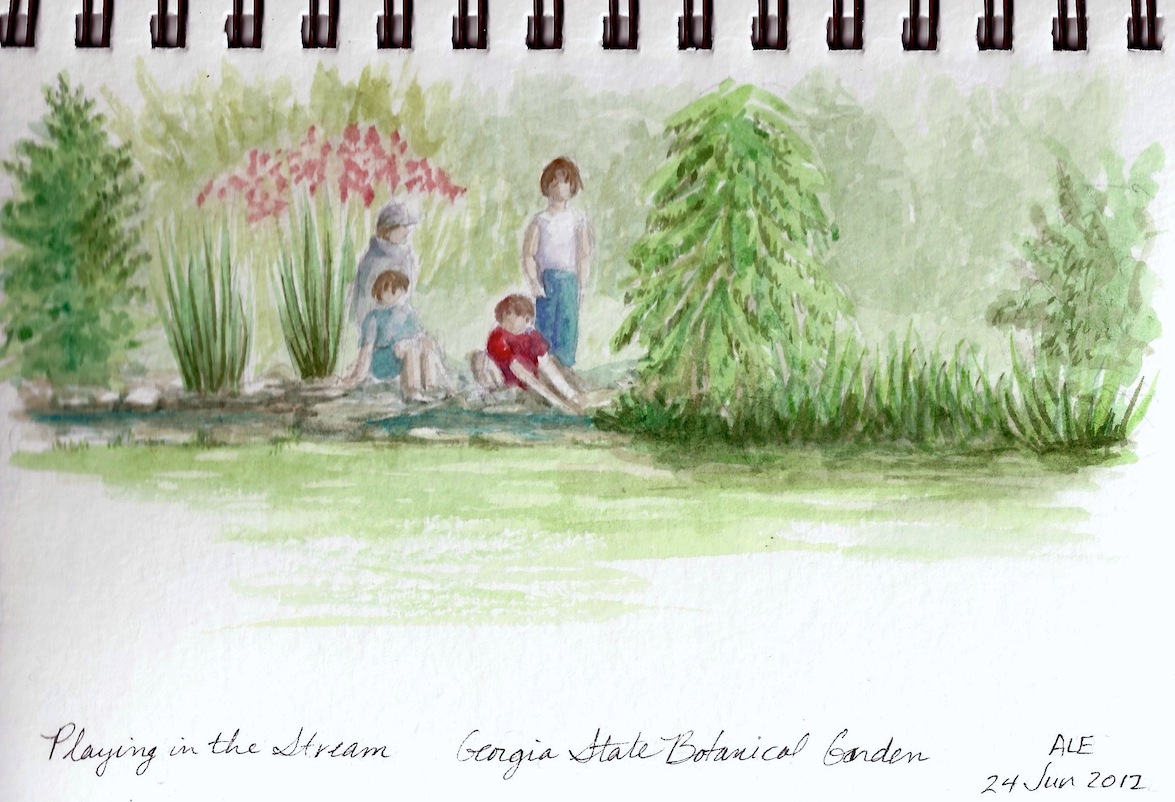
Other trails head toward the sunny lawn where the small creek wanders.  The creek is a popular spot for families to interact with nature.  We spent several hot summer nights sitting on a blanket enjoying a Sunflower outdoor music concert on the lawn.  


Thursday, August 30, 2012

UGA Trial Gardens

The University of Georgia has a wonderful little Trial Garden hidden away on campus.  When everything else is beaten down by the heat of summer, the trial gardens are a riot of colors.  Beds, pots and hanging plants filled with annual and perennials of every color.

There is so much packed into such a small space it is hard to decide what to paint. everywhere you look there is something to catch your eye, begging to be painted.  Over several weekends I have managed to paint just a few of the many plants at the Trial Gardens.

The Trial Garden had a whole bed of ornamental pepper plants.  They have been selected for both form and color, both the leaves and fruit come in many colors.  Some were large bushes, others trailed along the ground.  Some held their fruit up high while the fruit on others were hidden by the leaves.

Black-eyed Susans , Rudbeckia sp., are a common garden flower, but there are many different varieties now.  The Trial Garden has a bed full of different varieties.  Some are yellow, others orange or brown.  There are large flowers and small flowers, tall flowers and short flowers.  I made a composite sketch of only a few of these beautiful flowers.

Sunday, August 19, 2012

Owl Hill

Sometimes things just don't work as planned.  Last summer I had written a post to go with the sketches I did at Owl Hill.  For several reasons I didn't publish it at that time.  Latter, when I tried to 'Publish' it the post simply vanished!  So this is the second edition of the post.

Day Lilies never seem to mind the heat as much as we do.  While other flowers are fading, they are opening new flowers daily.  I have a few day lilies in my garden and look forward to seeing them bloom every year, but they don't compare to the day lilies around Owl Hill.   Here day lilies of every shade fill the summer garden with wonderful color.

There are many other plants in the well tended gardens at Owl Hill, and not all of them provide just flowers.  A zucchini runs along the ground, spilling over the rock wall onto the lawn.  Its large leaves reach for the sun between the rose bushes.  The birds don't mind the leaves that circled the base of the bird feeder, and the zucchini this plant produced were used to make many delicious breads.

Tuesday, July 3, 2012

Sapelo Island beaches


Nanny goat beach

A road leads directly from the Reynold's Mansion to Nanny goat beach.   The road passes through the marshes and ends at a parking area behind the dunes.  A boardwalk arches over the wind blown dunes to the beach.  Sun rise at the beach is a magical time.  The quiet warm glow of the sun turns the sky and sand pink.  

Ghost crabs (Ocypode quadrata) seem to fly across the beach from twilight until dawn foraging among the wrack.  As the sky brightens they head for cover. Their burrows are tucked beneath arching stalks of Sea oats (Uniola paniculata), among lengths of pennywort (Hydrocotyle sp.) and morning glory (Ipomoea sp.) that reach down from the dunes to the beach.  The area around an active burrow entrance is covered with numerous foot prints.

The dunes are formed by an accumulation of wind blown sand.  The loose sand of newly formed dunes is easily blown or washed away.  Older dunes, stabilized by plants, shift and move more slowly.  The extensive roots and runners of the beach plants help them stay anchored on the shifting sand.  As the plants grow they form a mat that traps more sand making the dunes more stable.

It may not look like it, but the surf zone is alive with worms, crabs, snails and clams.  You just may not notice them.  Their presence is known by all the burrow holes and trails.   By following the large trails in the sand we uncovered Shark's eye Moon snails (Neverita duplicata) and a Lettered Olives (Oliva sayana).  Both of these snails are active hunters who prey on smaller clams and snails.  Shells moon snails have fed on have a small round tell-tale bore hole.

There are traces of other animals on the beach too.  The Plume worm (Diopatra cuprea) cements shell and other debris to its tube.  Pieces of the tubes covered in Dwarf Surf clam (Mulinia laterals) and small Tellin shells were found washed up on the shore among the very colorful Coquina clams (Donax variables).  Numerous empty Coquina shells were scattered along the beach, the living clams are just at the waters edge.  Small breathing holes betray them.  If you look for them you can find clams washed out by the waves rapidly burrowing back in the sand.


Saturday, June 30, 2012

Sapelo Island Lighthouse


Lighthouse road runs along high land that curves around the salt marsh.  The lighthouse was built by Winslow Lewis and activated in 1820.  The lighthouse served as a guide for ships headed to Darien, and was equipped with fourth-order Fresnel lens.  A hurricane and tidal wave in 1898 covered the lower 18 feet of the tower for several hours causing severe damage to the foundation.

A replacement 100-foot steel pyramidal lighthouse tower was built, and the old lighthouse was left to decay.  These black and white photos were taken back in 1983.  Trees and bushes had grown up around the lighthouse.  The windows were gone and the interior was open to the weather.  Most of the stairs were missing, and the few remaining ones were seriously decayed.

In 1998 the lighthouse and neighboring oil house and cistern were restored.  The internal spiral staircase was rebuilt step by step and the exterior was repainted with its distinctive daymarks of six alternating red and white bands.  Today the lighthouse looks much like it did in 1820.

If you climb the 77 steps up to the top of the lighthouse to the lantern room you are treated to a panoramic view of the south end of the island and Doboy Sound.  Beyond the Range Lighthouse which was built in 1877, marshes stretch out toward the beach.  From here you can just see the ocean beyond the tree line of the dunes.